2026-北辰区-数学-一模-24题
题目条件
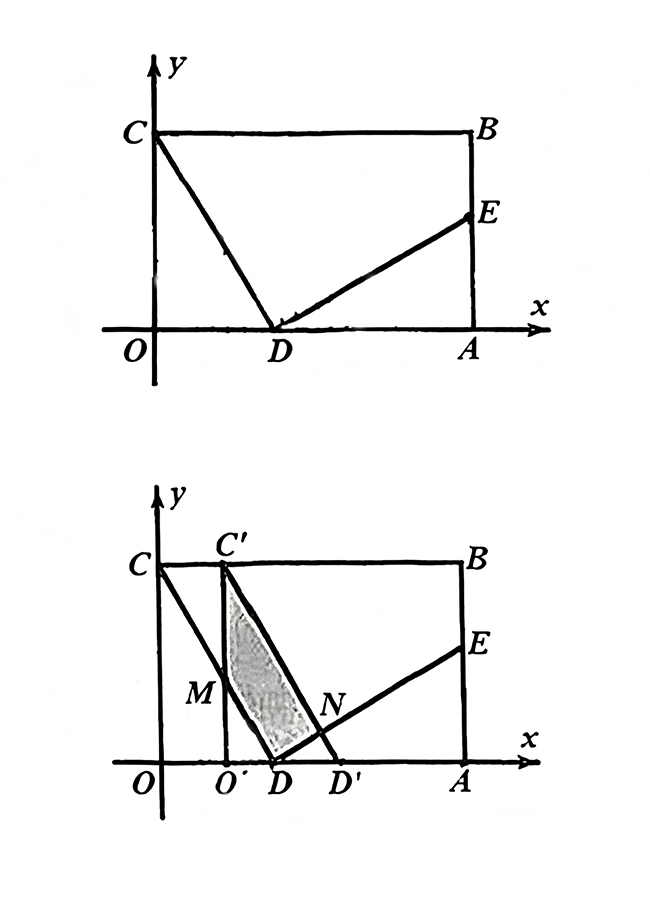
在平面直角坐标系中,O为原点,矩形OABC的顶点A在x轴正半轴,顶点C(0, 2√3)。D为OA上一点,∠ODC=60°,过D作DE⊥CD交AB于E,且DE=CD。
(Ⅰ) 填空:点D的坐标为______,点E的坐标为______;
(Ⅱ) 将△COD沿x轴向右平移,得到△C’O’D’,设OO’=t,△C’O’D’与四边形BCDE重叠部分的面积为S。
① 若重叠部分为四边形C’MDN,用含t的式子表示S,并写出t的取值范围;
② 当1≤t≤3时,求S的取值范围。
(Ⅰ) 求点D、E的坐标
1. 先看点D:在Rt△COD中,OC=2√3,∠ODC=60°,∠COD=90°。
\(\tan 60^\circ = \dfrac{OC}{OD} \implies \sqrt{3} = \dfrac{2\sqrt{3}}{OD}\)
解得 \(OD = 2\),所以点D的坐标为 \((2, 0)\)。
2. 再看点E:DE⊥CD,所以∠CDE=90°。
由∠CDO + ∠ADE = 90°,∠CDO + ∠OCD = 90°,得∠ADE=∠OCD。
又DE=CD,∠EAD=∠DOC=90°,所以△COD ≅ △DAE(AAS)。
由全等得:\(AD = OC = 2\sqrt{3}\),\(AE = OD = 2\)
\(OA = OD + AD = 2 + 2\sqrt{3}\),点E的横坐标为OA,纵坐标为AE,
所以点E的坐标为 \((2 + 2\sqrt{3}, 2)\)。
D(2, 0),E(2+2√3, 2)
(Ⅱ) ① 用含t的式子表示S(重叠为四边形时)
△COD的面积: \[ S_{\triangle COD} = \dfrac{1}{2} \times OD \times OC = \dfrac{1}{2} \times 2 \times 2\sqrt{3} = 2\sqrt{3} \] 平移后,△C’O’D’与△COD全等,面积仍为2√3。
重叠面积S,等于△C’O’D’的面积,减去两个小三角形的面积: \[ S = S_{\triangle C’O’D’} – S_{\triangle DMO’} – S_{\triangle DD’N} \]
1. 求\(S_{\triangle DMO’}\):
OO’=t,所以O’D = OD – OO’ = 2 – t。
∠CDO=60°,在Rt△DMO’中,MO’ = O’D × tan60° = √3(2-t)。
\[
S_{\triangle DMO’} = \dfrac{1}{2} \times O’D \times MO’ = \dfrac{1}{2}(2-t)\cdot\sqrt{3}(2-t) = \dfrac{\sqrt{3}}{2}(2-t)^2
\]
2. 求\(S_{\triangle DD’N}\):
DD’=t,△C’O’D’≌△COD,∠C’D’O’=∠CDO=60°,又C’D’∥CD,CD⊥DE,所以C’D’⊥DE,∠D’DN=30°。
在Rt△DD’N中:
\[
ND’ = DD’ \times \cos60^\circ = t \times \dfrac{1}{2} = \dfrac{t}{2}
\]
\[
DN = DD’ \times \cos30^\circ = t \times \dfrac{\sqrt{3}}{2} = \dfrac{\sqrt{3}}{2}t
\]
\[
S_{\triangle DD’N} = \dfrac{1}{2} \times ND’ \times DN = \dfrac{1}{2} \times \dfrac{t}{2} \times \dfrac{\sqrt{3}}{2}t = \dfrac{\sqrt{3}}{8}t^2
\]
3. 代入S的表达式: \[ S = 2\sqrt{3} – \dfrac{\sqrt{3}}{2}(2-t)^2 – \dfrac{\sqrt{3}}{8}t^2 \] 展开化简: \[ S = -\dfrac{5}{8}\sqrt{3}t^2 + 2\sqrt{3}t \] t的取值范围为\(0 < t < 2\)。
\[ S = -\dfrac{5\sqrt{3}}{8}t^2 + 2\sqrt{3}\,t \quad (0 < t < 2) \]
(Ⅱ) ② 当1≤t≤3时,求S的取值范围
1. 当1≤t<2时:
\(S = -\dfrac{5}{8}\sqrt{3}t^2 + 2\sqrt{3}t\),这是开口向下的二次函数,对称轴为\(t = -\dfrac{b}{2a} = \dfrac{8}{5} = 1.6\),在1≤t<2范围内。
\[
\text{当 } t=\dfrac{8}{5} \text{ 时,} S_{max} = \dfrac{8}{5}\sqrt{3}
\]
\[
\text{当 } t=1 \text{ 时,} S = -\dfrac{5}{8}\sqrt{3} + 2\sqrt{3} = \dfrac{11}{8}\sqrt{3}
\]
\[
\text{当 } t=2 \text{ 时,} S = -\dfrac{5}{8}\sqrt{3}\times4 + 4\sqrt{3} = \dfrac{3}{2}\sqrt{3}
\]
2. 当2≤t≤3时:
重叠部分变为△C’NI,C’D’=CD=4,∠D’C’O’=30°,ND’=t/2,所以C’N=4 – t/2。
IN = C’N × tan30° = (√3/3)(4 – t/2)。
\[
S = \dfrac{1}{2} \times C’N \times IN = \dfrac{1}{2} \times \left(4-\dfrac{t}{2}\right) \times \dfrac{\sqrt{3}}{3}\left(4-\dfrac{t}{2}\right) = \dfrac{\sqrt{3}}{24}(t-8)^2
\]
开口向上,对称轴t=8,在2≤t≤3上单调递减:
\[
\text{当 } t=2 \text{ 时,} S = \dfrac{\sqrt{3}}{24}(6)^2 = \dfrac{3}{2}\sqrt{3}
\]
\[
\text{当 } t=3 \text{ 时,} S = \dfrac{\sqrt{3}}{24}(5)^2 = \dfrac{25}{24}\sqrt{3}
\]
综合两部分,S的取值范围为:
\[ \dfrac{25\sqrt{3}}{24} \le S \le \dfrac{8\sqrt{3}}{5} \]